Insight 6 min read
UAE salt, sugar and fat limits: what changes for your recipe
On 6 Oct 2026 the UAE announced caps on sodium, total sugars and fat in five types of packaged food. What the numbers mean inside a formula, and where I’d start.

In 30 seconds
- Packaged bread, sweetened milk drinks, sweetened or flavoured yoghurt and laban, salty snacks and processed cheese now have caps per 100 g.
- Phase 1 is due 9 months after the rule takes effect (processed cheese: 2 years 3 months). Final limits by 31 Dec 2030.
- No start date is published yet. Lab-test every SKU, rank them by the gap and start trials now.
Your recipe now has a deadline. If you make or import packaged bread, sweetened milk drinks, sweetened or flavoured yoghurt and laban, salty snacks or processed cheese for the UAE, the formula you sell today has a limit to meet.
On 6 Oct 2026, the Ministry of Health and Prevention (MoHAP) said it has started implementing a resolution that caps sodium, total sugars and total fat in these foods. Local and imported products are covered, free zones included, from the factory to the shelf.
The headlines say salt, sugar and fat. The detail is more precise, and the detail is what your formula has to meet. Here is what the release says, what it means inside a product, and where I’d start.
Not every food gets every cap #
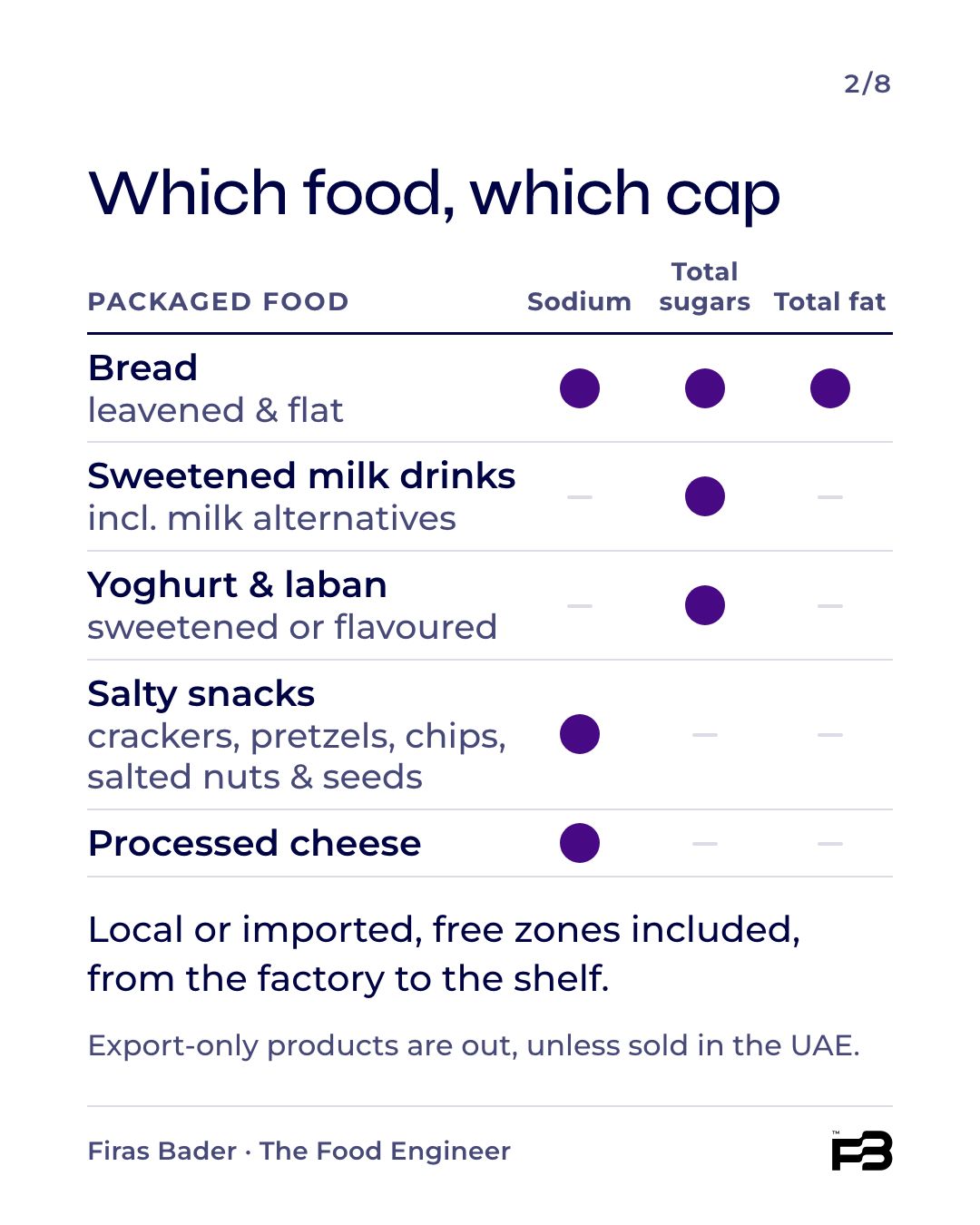
Bread is the only food with all three caps: sodium, total sugars and total fat. Salty snacks and processed cheese get a sodium cap. Sweetened milk drinks, milk alternatives included, and sweetened or flavoured yoghurt and laban get a sugar cap.
Three details change how you read your own label. Every limit is per 100 g of product, drinks included. The sugar caps are on total sugars, which on a label normally include the lactose that milk brings with it.
The limits are also written as sodium in milligrams, not as salt. And products made only for export are out, unless they are also sold in the UAE.
The numbers, per 100 g #
These are the limits I’d check first. Phase 1 is the first deadline; the final limit applies to everyone by the end of 2030.
-
444 → 370 mg
Sodium in leavened bread, phase 1 → final
Source: MoHAP release, 6 Oct 2026
-
12 → 10 g
Total sugars in sweetened or flavoured yoghurt and laban
Source: MoHAP release, 6 Oct 2026
-
9.6 → 8 g
Total sugars in sweetened milk drinks, milk alternatives included
Source: MoHAP release, 6 Oct 2026
-
564 → 470 mg
Sodium in chips and extruded snacks
Source: MoHAP release, 6 Oct 2026
Scroll the table sideways to see every column.
| Packaged food | Capped | Phase 1 | Final, by 31 Dec 2030 |
|---|---|---|---|
| Leavened bread | Sodium | 444 mg | 370 mg |
| Leavened bread | Total sugars | 6 g | 5 g |
| Leavened bread | Total fat | 8.4 g | 7 g |
| Flat bread | Sodium | 384 mg | 320 mg |
| Flat bread | Total sugars | 6 g | 5 g |
| Flat bread | Total fat | 8.4 g | 7 g |
| Sweetened milk drinks, incl. milk alternatives | Total sugars | 9.6 g | 8 g |
| Sweetened or flavoured yoghurt or laban | Total sugars | 12 g | 10 g |
| Salted crackers | Sodium | 696 mg | 580 mg |
| Salted nuts and seeds | Sodium | 336 mg | 280 mg |
| Pretzels | Sodium | 912 mg | 760 mg |
| Extruded snacks and chips (potato, sweet potato, vegetable or grain) | Sodium | 564 mg | 470 mg |
| Spreadable processed cheese | Sodium | 864 mg | 720 mg |
| Other processed cheese | Sodium | 1,200 mg | 1,000 mg |
Source: MoHAP release of 6 Oct 2026 (WAM text, via Zawya), checked against Khaleej Times and Gulf News.
One pattern is worth knowing. Every phase-1 limit is exactly 1.2 times the final one, so the final limits sit about 17% below phase 1. A product that only just passes phase 1 has a second round of reformulation ahead of it.
Have a nutrition panel or a lab report to hand? Try your own numbers below, per 100 g of product.
Calculator
Check a product against the UAE limits
Pick the food and the capped nutrient, then type your lab result per 100 g.
Your result shows here.
Indicative only. Limits per 100 g from the MoHAP release of 6 Oct 2026; phase 1 is due within 9 months of the start date (processed cheese: 2 years 3 months), final limits by 31 Dec 2030. No report gives the start date yet: check it with MoHAP. The exception (a phase-1 cut of more than 20%) is for products already on the UAE market, within 30 days of that date. Sources: MoHAP release (WAM text, via Zawya), 6 Oct 2026 (opens in a new tab) · Khaleej Times, 6 Oct 2026 (opens in a new tab) · Gulf News, 6 Oct 2026 (opens in a new tab)
The clock starts on a date nobody has published #
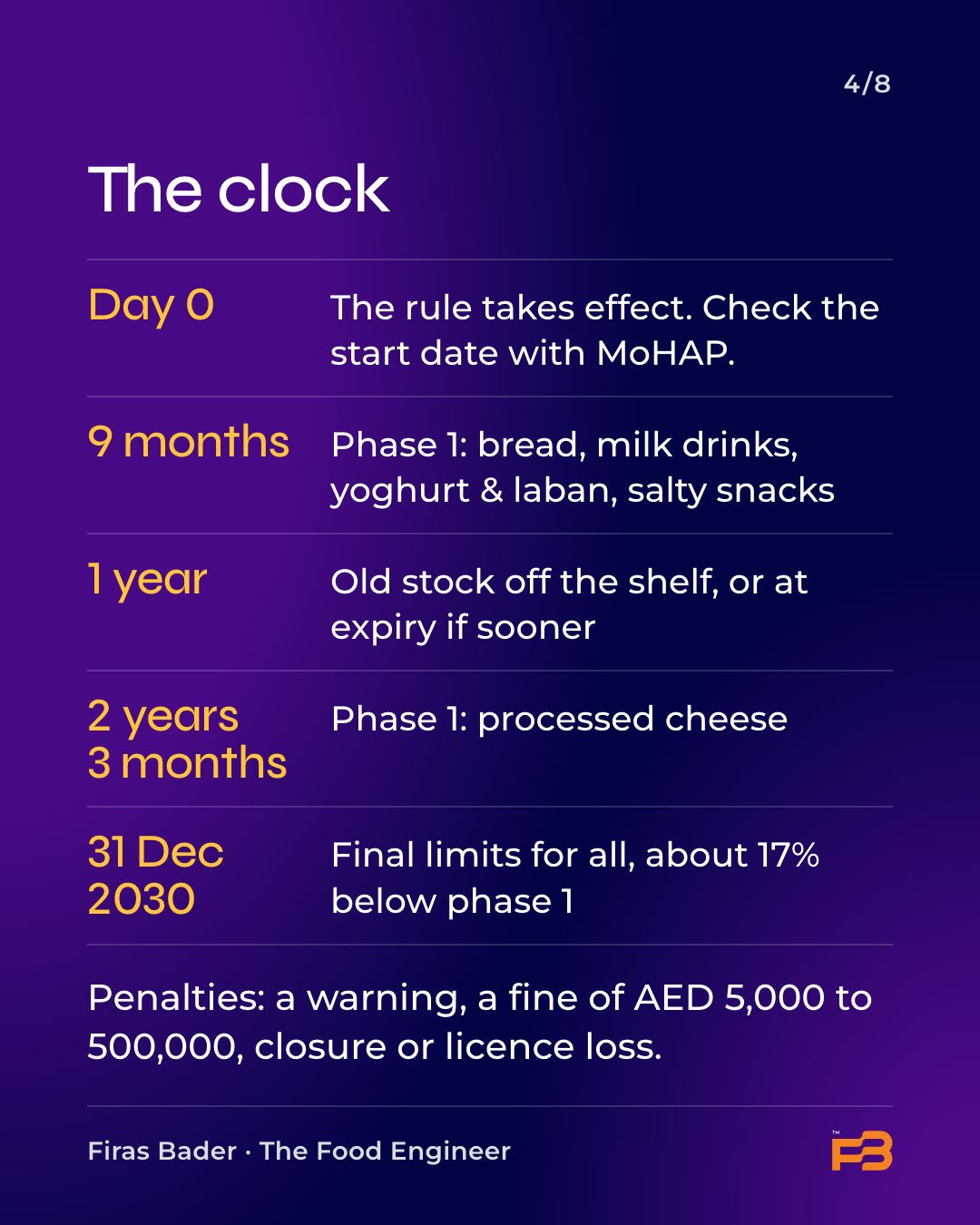
For bread, milk drinks, yoghurt and laban, and salty snacks, phase 1 is due within 9 months of the date the rule takes effect. Processed cheese gets 2 years and 3 months. Both groups must reach the final limits by 31 December 2030.
Stock made or imported before the start date can stay on sale for up to one year, or until it expires, whichever comes first. Penalties range from a warning to a fine of AED 5,000 to 500,000, closure for up to six months, or loss of the licence.
The 20% exception, and who can use it #
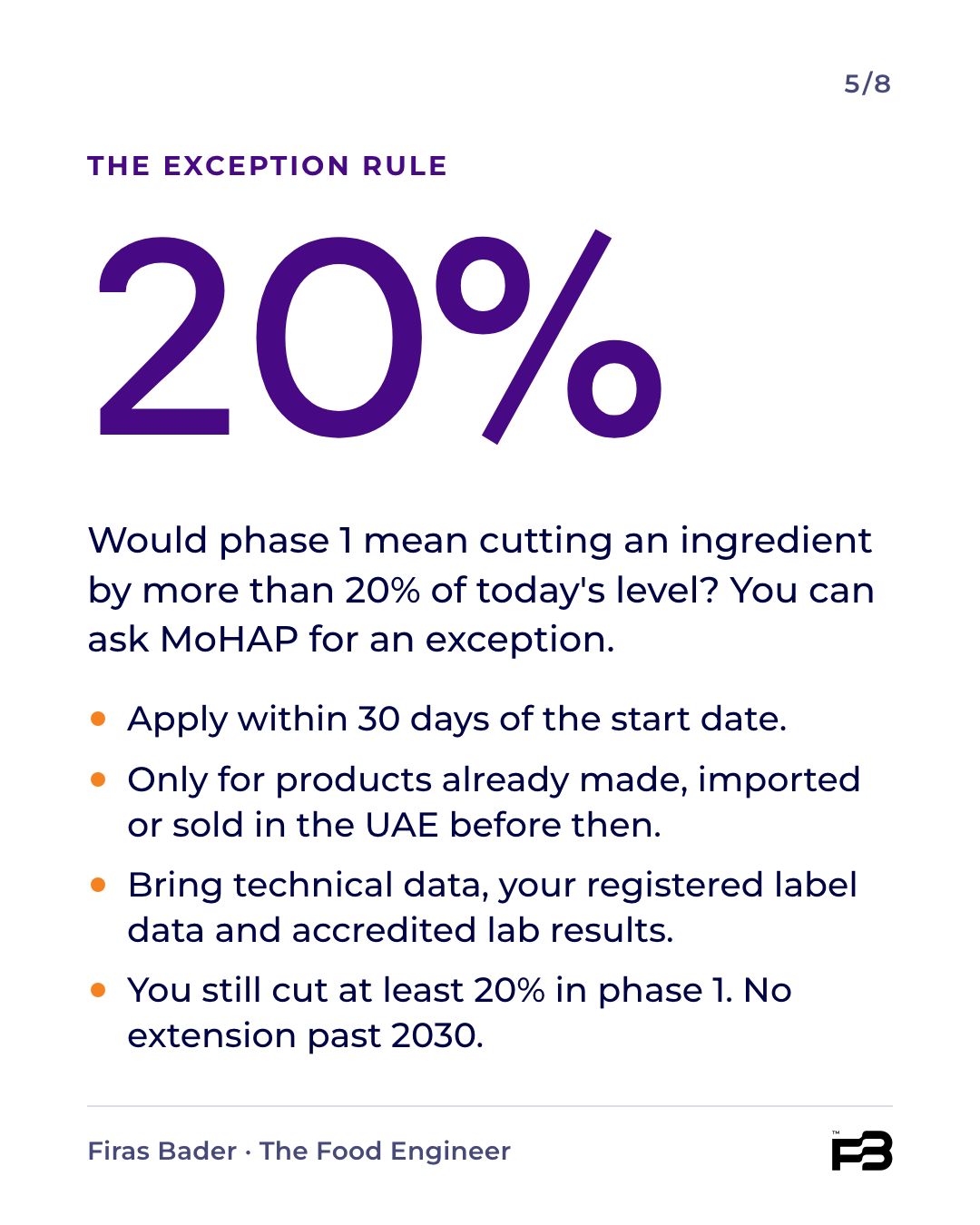
If meeting phase 1 would mean cutting an ingredient by more than 20% of its established content in the product, you can ask MoHAP for an exception. You apply within 30 days of the start date.
It only covers products already made, imported or sold in the UAE before that date, so a new launch can’t use it. The request needs technical data, your registered nutrition label data and results from an accredited lab. You still commit to cutting at least 20% in phase 1, and nothing extends past 31 December 2030.
A quick way to spot these products: a cut of more than 20% means today’s level is above 1.25 times the phase-1 limit. For leavened bread, that is anything above 555 mg of sodium per 100 g.
Why you can’t just take the salt out #
This is the part the headlines skip. Salt and sugar carry taste, and they also do structural work in the product.
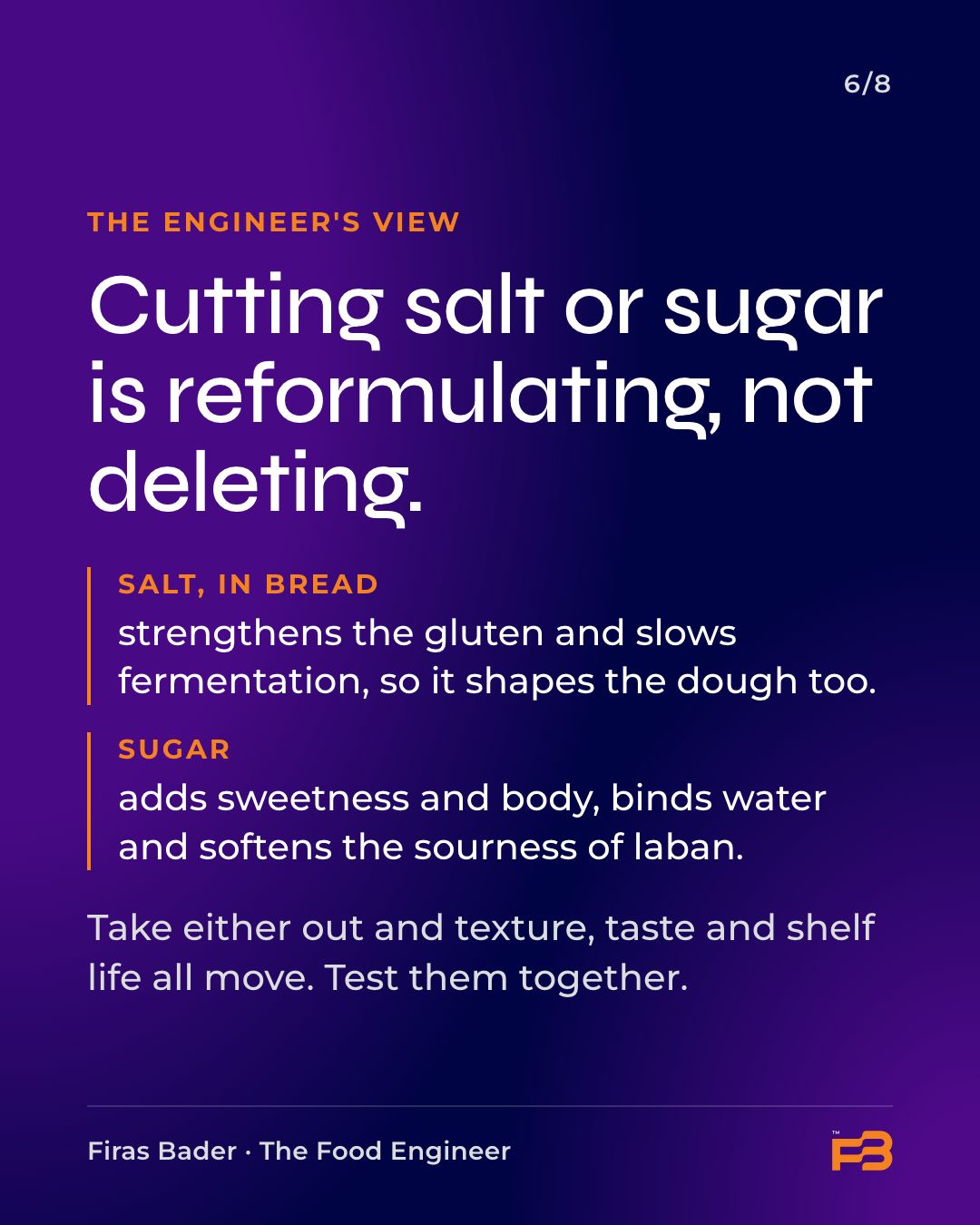
In bread, salt strengthens the gluten and slows fermentation, so it shapes the dough too. Take some out and the dough can turn slacker and ferment faster, so the process may need adjusting along with the recipe.
In laban and sweetened milk drinks, sugar adds sweetness and body, binds water and softens the sourness. Cut it and the drink can taste sharper and feel thinner. In chips and other seasoned snacks, much of the sodium sits in the seasoning on the surface, which makes the seasoning a natural first place to look.
Take any of them out and texture, taste and shelf life all move. That’s why I’d test them together.
Your first 3 steps #
-
Lab-test every SKU
Measure each product against the limit for its category, per 100 g. If you may need an exception, the request needs accredited lab results anyway.
-
Rank them by the gap
Biggest gaps first. Flag anything that needs a cut of more than 20%, because the exception window is only 30 days from the start date.
-
Start trials early
Test taste and shelf life together: on day one and at the end of shelf life. A recipe that meets the limit on day one but changes by the end of its shelf life isn’t finished.
Your SKU gap check
Ticks are saved on this device only.
What I’d do next #
I wouldn’t wait for the start date. The lab tests and the ranking take the same time whether the clock starts next week or next quarter, and the exception window is only 30 days long.
Then I’d start with the product that has the biggest gap and sells the most. It will show you early what the rest of the range is likely to need.
If you’re working through your SKUs, happy to compare notes. Tell me about your product.
Sources
Every number here comes from these sources. Read them before you rely on a figure.
- MoHAP release: caps on sodium, sugar and fats in selected food products (WAM text, via Zawya) (opens in a new tab) ·
- Khaleej Times: UAE sets new sodium, sugar and fat limits; violators face fines up to Dh500,000 (opens in a new tab) ·
- Gulf News: UAE sets up to Dh500,000 fine for food exceeding salt, sugar limits (opens in a new tab) ·
Your turn
Which will be hardest to fix?
Vote, then see what other readers chose.
Discuss this with Firas
Facing this in your own product? Send me a line on WhatsApp, or tell me about it on the contact page.
Projects behind this article
Confidential · Dry mix
Cake mix optimisation
The cake collapsed after baking.
Collapse fixed Status: Reformulated
ProPop · Snack
Factory process and oxidation control
The oil-rich coating is the shelf-life weak point.
Factory SOP Status: Formula delivered